

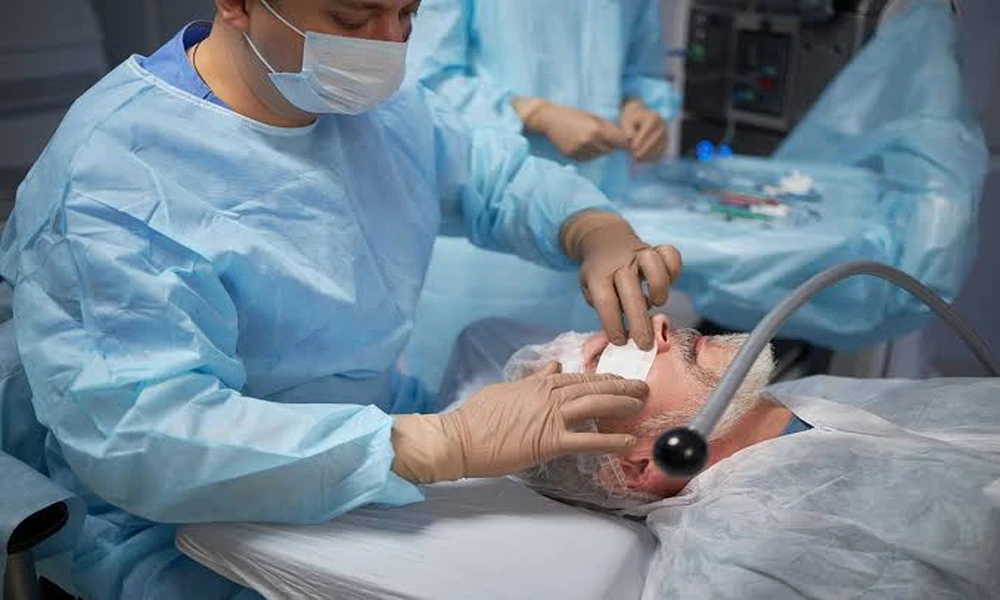
Many people who have always seen well at near distances begin holding a phone or book farther away during their forties. This age-related focusing change is called presbyopia. Laser procedures can sometimes reduce dependence on reading glasses by creating a different focusing balance between the eyes, but they do not restore the natural lens to its younger flexibility. A 2023 systematic review and meta-analysis of LASIK for presbyopia found generally useful near-vision and predictability outcomes while also identifying trade-offs in distance-vision measures.
Why does reading become harder after 40?
Inside the eye is a natural lens that changes shape when we focus on nearby objects.
As people age, this lens gradually becomes less flexible.
The focusing muscles can no longer change its shape as easily, so close objects become difficult to see clearly.
This is presbyopia.
It is different from long-sightedness caused by the overall focusing shape of the eye, although the two conditions can occur together.
Why does ordinary distance LASIK not solve the whole problem?
Traditional laser treatment can correct short-sightedness, long-sightedness, or astigmatism by reshaping the cornea.
If both eyes are corrected only for sharp distance vision, a person with presbyopia may still need reading glasses.
The underlying lens is still age-related and cannot regain its original flexibility through corneal laser treatment.
This is why presbyopia laser strategies usually aim to extend the useful range of vision rather than actually making the natural lens young again.
What is blended vision?
Blended vision is based on a similar principle to monovision.
One eye is usually set mainly for distance vision, while the other is given more support for intermediate or near tasks.
The brain combines the visual information from both eyes during everyday activities.
AccuVision describes its presbyopia laser approach as blended vision, with the two eyes set to provide a broader functional range.
Not everyone adapts equally well.
Why is a contact-lens trial useful?
Before making a permanent surgical decision, some patients can experience a temporary version of monovision or blended vision using contact lenses.
This can provide an idea of what it feels like to use the eyes at slightly different focal distances.
A trial may reveal difficulties with:
- Depth perception
- Fine distance detail
- Night driving
- Reading endurance
- Screen work
- Sports
- Visual comfort
A successful trial does not guarantee a surgical result, but it can provide useful information.
Are there trade-offs?
Yes.
Improving near vision without glasses may mean accepting some compromise in another aspect of vision.
A systematic review comparing monovision with multifocal approaches found that the balance between spectacle independence and aspects of visual quality varies between strategies.
People who require extremely precise binocular distance vision may be less comfortable with a monovision approach.
Examples may include people whose occupation or sport depends heavily on depth perception.
Night drivers should also discuss contrast and low-light vision.
What if someone already has cataracts?
This is an important question.
Presbyopia and cataracts both involve the natural lens, but they are not the same condition.
If a cataract is beginning to reduce vision, corneal laser surgery may not be the most appropriate long-term solution.
Lens-based surgery may be considered instead in some patients because it can address the cloudy natural lens and the focusing prescription at the same time.
This decision depends on age, lens clarity, prescription, eye health, and visual priorities.
Can presbyopia return after treatment?
The eye continues to age after laser treatment.
Presbyopia is a progressive age-related process, so near-vision needs may change with time.
A patient who initially functions without reading glasses may later need them for very small print, dim lighting, or prolonged reading.
This possibility should be discussed before surgery.
Who needs especially careful assessment?
Detailed assessment is important for people with:
- Cataract
- Significant dry eye
- Glaucoma
- Retinal disease
- Previous eye surgery
- A large difference between the two eyes
- Frequent night-driving needs
- Occupations requiring precise depth perception
- Unrealistic expectations of permanent spectacle independence
An eye examination should determine whether reduced near vision is simply presbyopia or whether another eye condition is present.
What should patients ask?
Useful questions include:
- Is presbyopia the main reason my near vision has changed?
- Is my natural lens clear?
- Would blended vision suit my occupation?
- Can I trial the effect before surgery?
- What happens to my depth perception?
- Will I still need reading glasses sometimes?
- How might night driving be affected?
- Are there lens-based alternatives?
- How might my vision change as I get older?
People considering treatment can read about AccuVision’s presbyopia laser eye surgery options, including its blended-vision approach.
No treatment can guarantee permanent freedom from glasses. A suitable plan should balance near vision, distance vision, lifestyle needs, eye health, and natural ageing.
This article is intended for general education and does not replace an individual refractive or cataract assessment.