

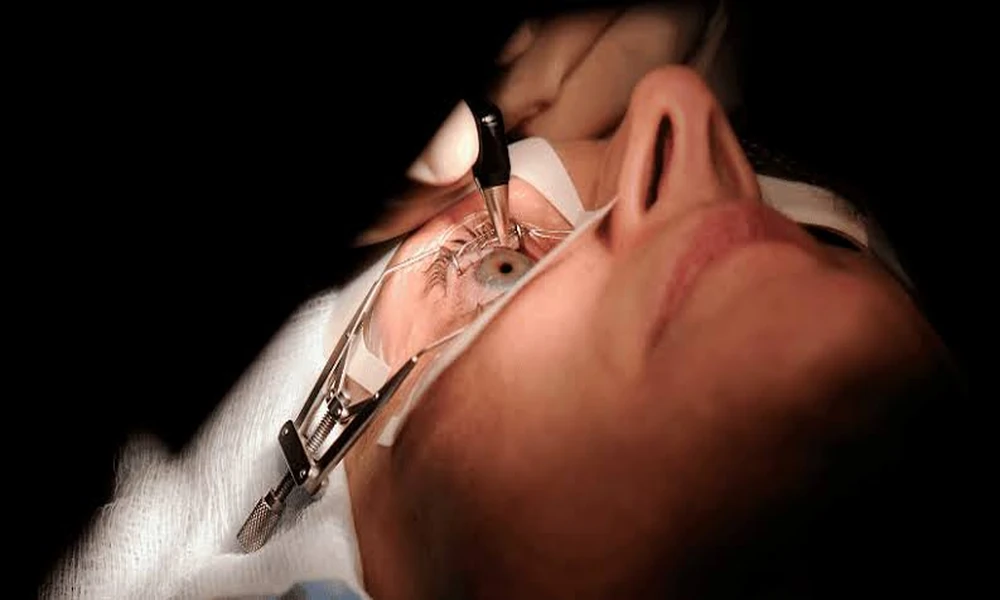
People with a strong short-sighted prescription are sometimes told that their prescription alone determines whether laser eye surgery is possible. In reality, suitability is more complex. A large 2025 analysis comparing LASIK outcomes in people with high and low myopia found satisfactory short-term outcomes in both groups, although the high-myopia group had slightly less favourable refractive results. This highlights why people with stronger prescriptions require careful individual assessment rather than a simple yes-or-no decision based on dioptres alone.
Short-sightedness, also called myopia, occurs when light entering the eye focuses in front of the retina rather than directly on it. As a result, distant objects appear blurred.
Glasses and contact lenses correct the way light enters the eye. Laser eye surgery takes a different approach by changing the shape of the cornea.
For someone with high myopia, however, the amount of corneal reshaping needed may be greater. That makes several additional measurements particularly important.
What is high myopia?
Myopia is measured in dioptres. A more negative number generally represents stronger short-sightedness.
High myopia is commonly described as a prescription of around -6.00 dioptres or greater, although definitions can vary slightly between clinical and research settings.
People with high myopia may depend heavily on glasses or contact lenses for everyday tasks such as driving, recognising faces, watching television, or seeing signs at a distance.
A strong prescription also has implications beyond spectacle dependence.
Highly myopic eyes may have an increased lifetime risk of certain retinal and other eye conditions. This is why refractive surgery assessment should not focus solely on removing the need for glasses.
Why does corneal thickness matter?
LASIK and other corneal laser treatments work by removing a calculated amount of corneal tissue.
Generally, stronger corrections require more reshaping than mild prescriptions.
The clinician therefore needs to know whether enough suitable corneal tissue will remain after treatment.
Corneal pachymetry measures thickness, while topography and tomography assess the shape of the cornea.
These tests can help identify irregularities that may make corneal laser surgery inappropriate.
The amount of tissue left after treatment is an important safety consideration because excessive weakening of the cornea can contribute to a rare complication called corneal ectasia.
Long-term research in highly myopic eyes has reinforced the importance of appropriate screening and preservation of corneal tissue.
Prescription strength is not the only measurement
Two people with the same glasses prescription may receive different recommendations.
One may have a thick, regularly shaped cornea and stable prescription.
The other may have a thinner cornea, irregular topography, significant dry eye, or another condition that changes the risk-benefit balance.
Assessment may therefore include:
- Current prescription
- Previous prescriptions
- Corneal thickness
- Corneal topography or tomography
- Pupil size
- Tear-film and dry-eye assessment
- Eye pressure
- General eye health
- Retinal examination
- Age
- Medical history
- Previous eye surgery
- Occupation and lifestyle
The aim is to determine whether laser treatment is appropriate for the whole eye, not merely whether a machine can technically programme the prescription.
Why should the retina be examined?
High myopia is usually associated with an eye that is longer than average.
This can stretch structures at the back of the eye.
Some highly myopic people have an increased risk of retinal tears, retinal detachment, myopic macular changes, or other retinal problems.
Laser vision correction changes the focusing power of the cornea. It does not shorten the eyeball or remove the underlying retinal risks associated with high myopia.
Someone who no longer needs strong glasses after treatment may therefore still require regular eye-health checks.
Symptoms such as new flashing lights, a sudden shower of floaters, or a dark curtain entering the vision require urgent assessment whether or not refractive surgery has been performed.
Does a strong prescription mean LASIK is impossible?
No, but it also does not mean LASIK is automatically suitable.
Modern refractive surgery can treat a broad range of prescriptions in appropriately selected patients.
AccuVision currently states that its short-sightedness treatment planning is customised according to individual diagnostic findings and that it treats a broad range of myopic prescriptions.
However, a clinic’s published treatment range should never be treated as a guarantee that a particular patient qualifies.
Corneal structure, eye health, age, prescription stability, and expected tissue removal must still be considered.
What alternatives may be considered?
Someone who is not suitable for LASIK may still have other options.
- Surface laser treatment such as PRK or Trans-Epi PRK
- Contact lenses
- Glasses
- Implantable collamer lenses
- Another refractive approach
- No surgery
An implantable lens may sometimes be considered in people with high myopia, particularly when corneal laser treatment would require excessive tissue removal.
A recent network meta-analysis examining optical quality after different refractive procedures found that implantable collamer lenses performed favourably for several higher-order aberration measures, although procedure selection still depends on the individual patient.
This does not mean an implantable lens is universally better. Unlike corneal laser surgery, it is an intraocular procedure and therefore has its own risks.
What about surface laser treatment?
Surface procedures reshape the cornea without creating a LASIK flap.
They may preserve some tissue associated with flap creation, but stronger corrections can still require substantial corneal reshaping.
Research comparing LASEK with LASIK has shown that outcomes can vary with the degree of myopia, and higher corrections require particular care in procedure selection.
A surface treatment should therefore not be presented as an automatic solution for every thin cornea or high prescription.
Will laser surgery permanently eliminate myopia?
Laser treatment permanently changes the shape of the treated corneal tissue, but the eye itself can continue to change.
Some patients experience a degree of regression or a new prescription over time.
Age-related near-vision changes can also develop later.
People with high myopia should therefore be cautious of claims such as “permanent perfect vision” or “glasses-free for life.”
The realistic goal is usually to reduce dependence on glasses or contact lenses while maintaining an appropriate safety margin.
What should happen during an assessment?
People with stronger prescriptions should expect a detailed evaluation.
The clinician should explain:
- Whether the prescription is stable.
- Whether the corneal shape is normal.
- How much corneal tissue the proposed correction requires.
- Whether the retina is healthy.
- Whether LASIK or a surface procedure is appropriate.
- Whether an implantable lens should also be considered.
- What level of vision can realistically be expected.
- Which risks may be greater because of the prescription.
- Whether glasses may still be needed for some activities.
AccuVision provides information about laser eye surgery for short-sightedness and describes individual diagnostic assessment as part of determining the appropriate treatment approach.
A good refractive consultation should leave the patient understanding not only what can potentially be corrected but also what should not be treated.
For people with high myopia, careful screening is more important than the headline treatment range of a laser.
Seek urgent ophthalmic care for sudden vision loss, a curtain or shadow across the vision, sudden flashing lights with numerous new floaters, severe eye pain, or significant eye trauma.
This article is intended for general education and does not replace an individual examination or advice from an ophthalmologist or refractive-surgery professional.