
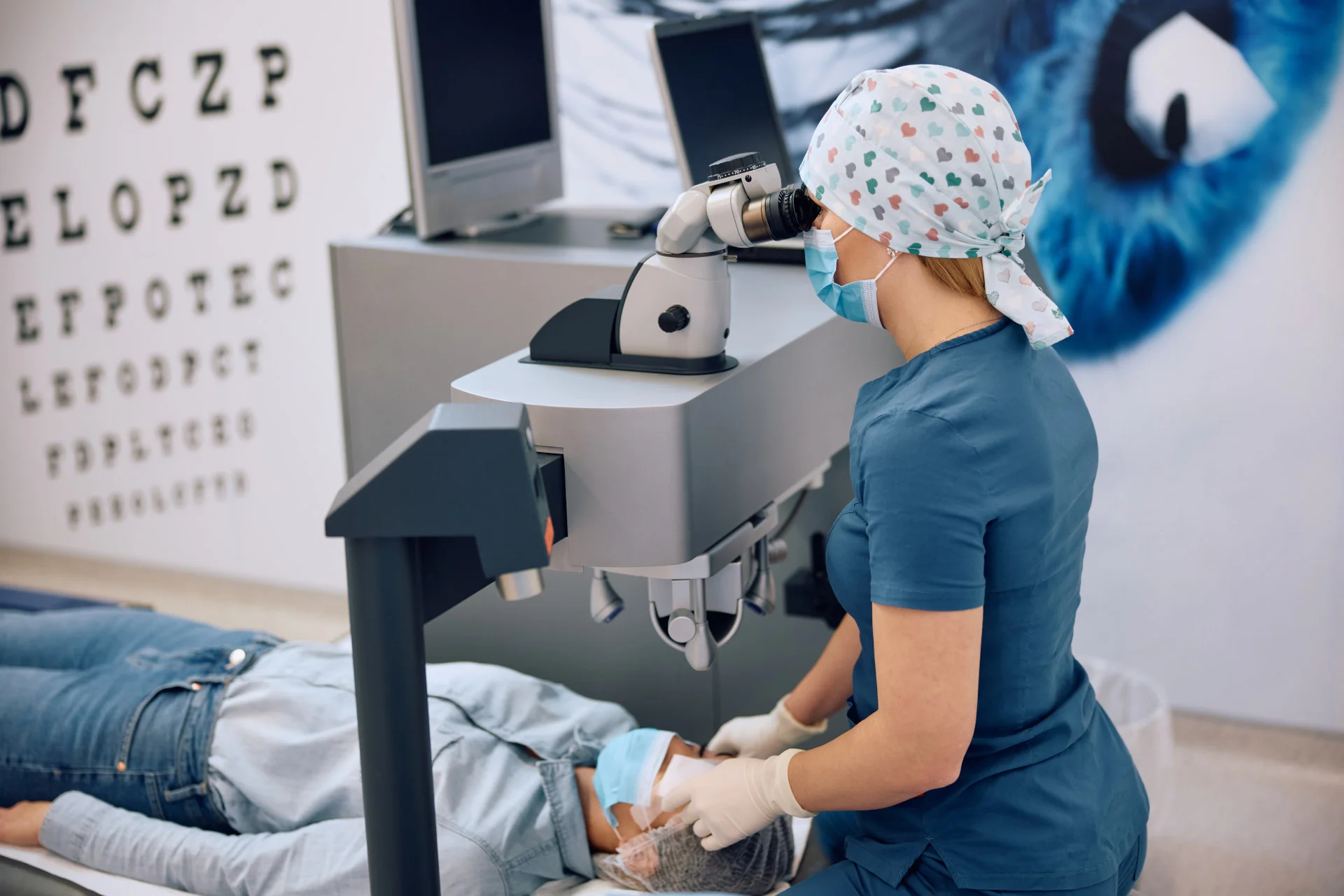
LASIK is widely recognised, but it is not the only laser procedure used to correct refractive errors. Photorefractive keratectomy, or PRK, reshapes the cornea without creating the type of corneal flap used in LASIK. A 2026 meta-analysis comparing transepithelial PRK with LASIK and SMILE found broadly comparable efficacy and predictability across the procedures studied, while confirming that the procedures have different practical and recovery characteristics.
The correct procedure depends on the individual eye.
A person should not choose PRK merely because an advertisement calls it safer, nor choose LASIK only because the initial recovery may be faster.
How does LASIK work?
During LASIK, a thin flap is created in the cornea.
The flap is lifted, laser energy reshapes the underlying corneal tissue, and the flap is returned to its position.
Because the surface epithelium is largely preserved, useful vision often returns relatively quickly.
The existence of the flap creates its own considerations, particularly for corneal anatomy and activities involving potential direct impact.
How does PRK work?
PRK is a surface procedure.
The thin epithelial layer at the front of the cornea is removed, and an excimer laser reshapes the underlying corneal tissue.
The epithelium then grows back.
A temporary bandage contact lens is commonly used during the early healing period.
Phiroze Dastoor describes its Custom PRK service as a surface-based, flap-free procedure and states that a bandage contact lens is typically used during the first several days of healing.
Why may PRK be considered instead of LASIK?
One reason can be corneal anatomy.
LASIK requires an appropriate corneal thickness and shape for flap creation and tissue removal.
In some patients, a surface approach may provide a more appropriate treatment plan because there is no LASIK flap.
Lifestyle may also influence the discussion.
People involved in contact sports or activities with a meaningful chance of direct eye trauma may prefer to avoid having a corneal flap.
This does not mean every athlete should have PRK.
The prescription, corneal shape, dry-eye status and other eye-health factors still need to be considered.
Is PRK suitable for thin corneas?
Sometimes, but this requires careful wording.
A thinner cornea does not automatically make PRK safe.
Every laser procedure removes corneal tissue.
If the cornea is too thin, irregular, biomechanically weak, or suspicious for keratoconus, refractive laser surgery may be inappropriate altogether.
Corneal topography, tomography and pachymetry are therefore essential parts of refractive-surgery screening.
Phiroze Dastoor’s PRK page states that the procedure may be considered for selected people with thinner corneas or where flap creation is not recommended.
How does recovery differ?
PRK usually has a slower initial recovery than LASIK because the epithelial layer must regenerate.
Early symptoms may include:
- Light sensitivity
- Watering
- Grittiness
- Discomfort
- Fluctuating vision
A historical Cochrane review found faster recovery and less early discomfort with LASIK, while one-year visual outcomes were broadly comparable in the trials reviewed. The authors also noted that much of the evidence involved older techniques and that contemporary procedures continued to require research.
Modern laser platforms have evolved, but the basic difference in surface healing remains relevant.
Does custom treatment guarantee better than 20/20 vision?
No.
“Custom” usually refers to treatment planning informed by individual measurements such as wavefront or corneal data.
It should not be interpreted as a guarantee of perfect vision.
Possible outcomes after PRK include:
- Residual prescription
- Dry-eye symptoms
- Glare or halos
- Corneal haze
- Infection
- Delayed healing
- Need for glasses
- Need for additional treatment in selected cases
Serious complications are uncommon but must be included in informed consent.
What happens before surgery?
Assessment may include:
- Stable prescription history
- Corneal thickness
- Corneal shape
- Tear-film evaluation
- Pupil measurements
- Eye pressure
- Retinal examination
- Medical history
- Medication review
- Previous eye surgery
Pregnancy, unstable prescription, active eye disease, significant dry eye, keratoconus, or certain general medical conditions can influence timing or suitability.
Who should ask about PRK?
A discussion about Custom PRK laser vision correction may be reasonable when someone is interested in laser correction but requires a flap-free approach based on corneal measurements, occupation, sport, or another clinical factor.
It should still be compared with LASIK, glasses, contact lenses and any other appropriate options.
The safest recommendation is the one supported by the person’s actual measurements rather than a predetermined preference for one procedure.
Seek urgent eye care after any refractive surgery for significant pain that is worsening, sudden vision reduction, marked redness, discharge, or injury to the treated eye.
This article is intended for general education and does not replace refractive-surgery assessment or informed consent.