

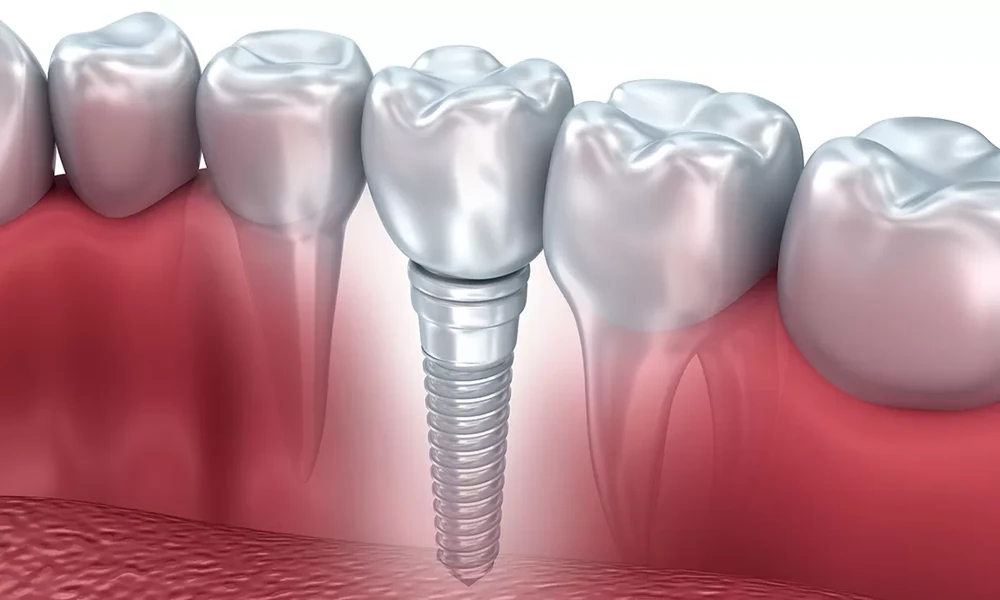
A single dental implant with its abutment and crown generally runs $3,000 to $6,000 in the United States, and the spread is that wide because one implant is really several billable procedures stacked together. Patients collecting estimates from practices such as Stubbs Dental and other implant-focused offices often find quotes that differ by thousands, not because one office is gouging them, but because the quotes cover different things. Knowing which line items belong in the number is the difference between comparing prices and guessing.
What does one implant cost from start to finish?
Plan on $3,000 to $6,000 for a straightforward single-tooth case with no major bone work. The surgical portion alone, meaning the titanium post placed in the jaw, is commonly quoted at $1,500 to $2,500, and the restoration on top accounts for most of the rest.
Geography moves the number more than almost anything else. The American Dental Association’s Health Policy Institute publishes survey data on dental fees by region, and the same code can differ 30 percent or more between a rural practice and a coastal metro.
What is actually on the bill?
Ask for the estimate itemized by CDT code, the standardized procedure codes the ADA maintains and insurers use. A typical single-implant treatment plan includes some mix of:
- 3D cone beam scan, code D0367, around $150 to $400
- Extraction of the failing tooth, roughly $150 to $400 simple, up to $800 if it needs to be sectioned out
- Socket preservation graft at the time of extraction, $300 to $1,200
- Implant placement, code D6010, $1,500 to $2,500
- Custom abutment, code D6057, $300 to $600
- Implant-supported crown, code D6058, $1,000 to $2,500
- A temporary tooth to wear while the bone heals, $300 to $600
Two estimates that look $2,000 apart frequently turn out to be identical once the cheaper one adds the abutment and crown it never mentioned.
When does the price climb past that range?
Bone deficiency is the usual reason a quote jumps. A sinus lift, needed when an upper molar site lacks vertical bone under the sinus floor, adds roughly $1,500 to $3,000. Ridge augmentation with block or particulate grafting to widen thin bone lands in a similar range and can push the whole timeline out by four to nine months.
Front teeth cost more than molars, since matching the shade and gum contour of a visible tooth takes custom lab work. Zirconia implants, chosen for a metal-free option, carry a premium over titanium.
What does full-arch treatment cost?
Full-arch replacement, marketed as All-on-4 or All-on-X, means a fixed bridge of teeth anchored on four to six implants, and it typically costs $20,000 to $35,000 per arch. Both arches commonly reach $35,000 to $60,000 depending on materials, since acrylic teeth cost far less than zirconia.
A cheaper alternative is the implant-supported overdenture, which snaps onto two implants and comes out for cleaning, closer to $6,000 to $15,000 per arch. Its plastic retention attachments wear out and need replacing every year or two.
Does dental insurance pay for implants?
Many plans now cover implants at around 50 percent after the deductible, but annual maximums of $1,000 to $2,000 mean the benefit rarely covers more than a fraction. Waiting periods of 6 to 12 months for major work are common, and a missing tooth clause excludes teeth that were already gone when the policy started.
One practical move: split treatment across two benefit years. Extraction and grafting in December, implant placement in January, and the annual maximum applies twice. Original Medicare does not cover routine dental care, though some Medicare Advantage plans include a limited allowance. HSA and FSA dollars can be used, since the IRS treats dental treatment as a qualified medical expense under Publication 502.
Are the cheaper routes worth it?
University dental school clinics often charge 30 to 50 percent below private practice fees, the trade-off being longer appointments with supervised residents. Dental savings plans, which are membership discounts rather than insurance, typically shave 15 to 25 percent off.
Treatment abroad in Mexico or Costa Rica can cut the price by half, and the real risk is not the surgery. It is the parts. If the implant uses a system your local dentist cannot get components for, a loose crown five years later becomes a much bigger repair.
How should you compare quotes between practices like Stubbs Dental and a lower bid?
Ask every office the same five questions: what is the all-in total including the crown, which implant system do you use, are the 3D scan and guided surgery included, what is the warranty if the implant fails, and who handles the restoration. Offices that both place and restore implants bill from one fee schedule, which removes the surprise of a second bill from a separate dentist. Stubbs Dental is one practice organized that way, and its treatment planning material is a useful benchmark when you are holding two quotes and cannot tell why they differ.
Implant pricing looks opaque until the estimate is broken into codes, at which point most of the mystery disappears. Get a written, itemized plan from two offices, and confirm what your insurance year allows before scheduling. Whether you end up at Stubbs Dental or somewhere closer to home, the office willing to hand you an itemized quote without being asked twice is usually the one worth trusting with the surgery.